Colorful Stage Interview: Tomori Kusunoki and Rui Tanabe at Anime NYC 2026
Hatsune Miku: Colorful Stage! brought Tomori Kusunoki, the voice of Kanade, and Rui Tanabe, the voice of Mafuyu, to a Javits Center press conference on the Saturday of Anime NYC 2026, with Eugene Musinski, Global Marketing Team Manager (SEGA of Japan), answering alongside them. Both actresses answered The Natural Aristocrat® in Japanese through an interpreter at the table.
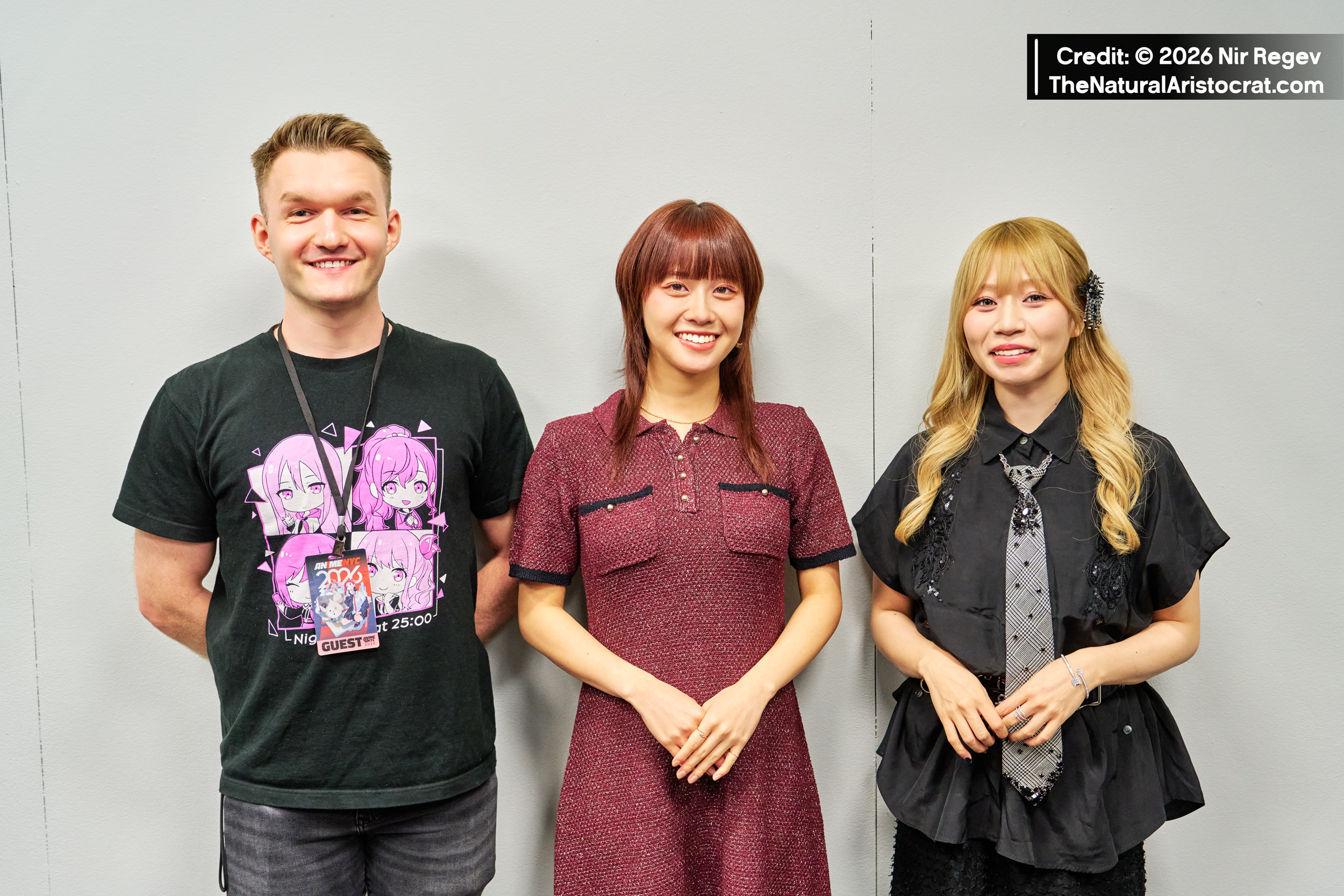
Eugene Musinski of SEGA with Tomori Kusunoki and Rui Tanabe at the Javits Center. Photograph © 2026 Nir Regev · The Natural Aristocrat®
Javits Center, New York
THE NATURAL ARISTOCRAT (NIR REGEV): To Tomori and Rui – What can your character express through singing that she cannot say directly?
TOMORI KUSUNOKI, on Kanade: In the story as well, rather than singing her own pain, Kanade is a character whose wish to stay close to someone, to cheer someone on, is the stronger thing.
So I always record hoping I can deliver the feeling to whoever is listening, too, that you are not alone, that we are all in this together, that it is going to be all right.
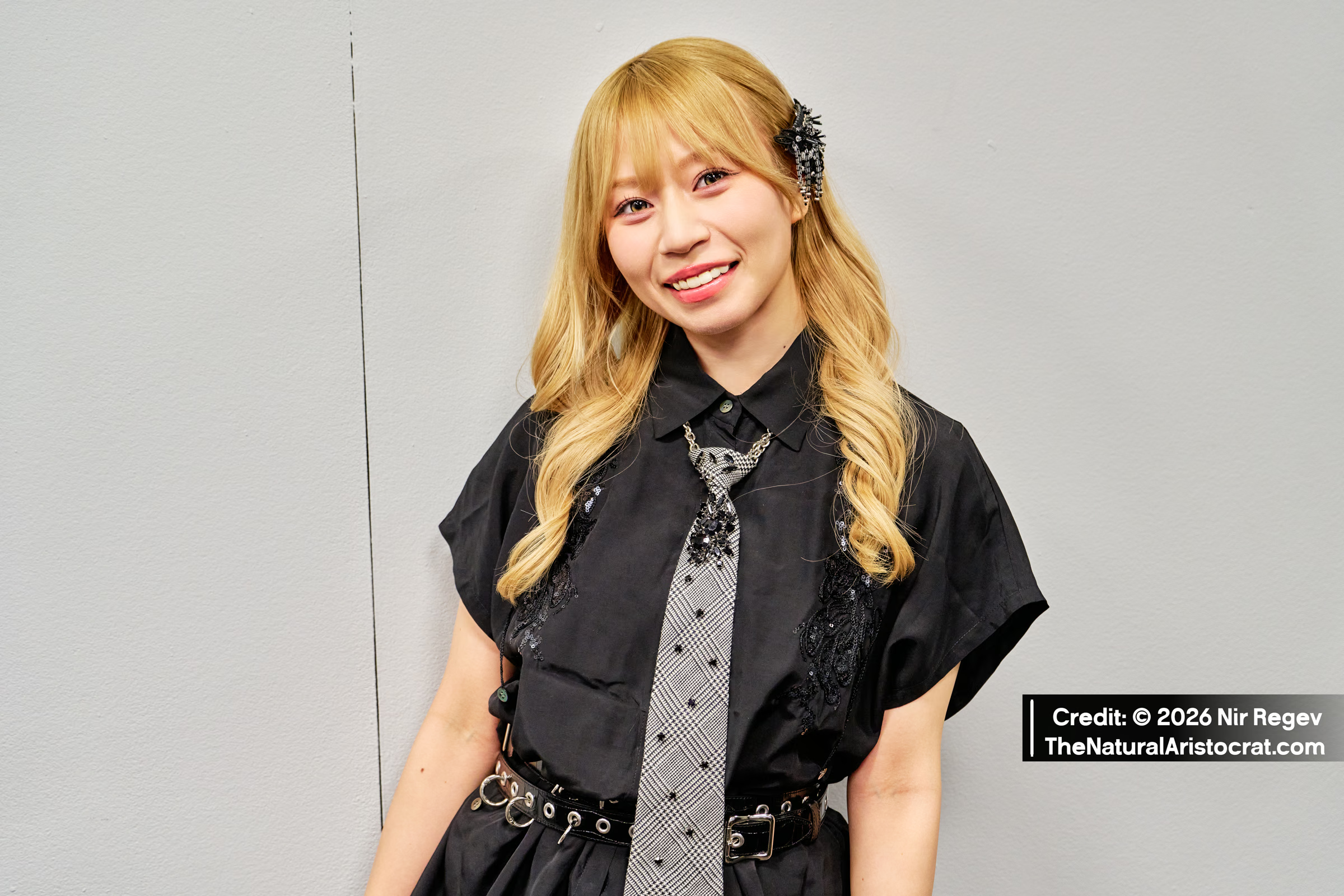
Rui Tanabe. Photograph © 2026 Nir Regev · The Natural Aristocrat®
RUI TANABE, on Mafuyu: For Mafuyu, I think song is the place where she can let out her pain. In her everyday life she feels nothing, but in song she can let out suffering, loneliness, wanting to disappear. I think it is the only world where she can let those feelings out.
EUGENE MUSINSKI: To give a little more context from my side. Specifically for that character, she is putting on a mask in her daily life. The only time she can actually be herself is when she sings. So through that singing, Tanabe-san also tries to show those darker emotions, because inside, Mafuyu is not the perfect girl she tries to be outside.
She is really depressed, sad, in a very bad place emotionally, and that is one of the main parts of the story. How do you manage those expectations, from parents, from the outside world, while also feeling that pressure as a child? I think those kinds of emotions are what Tanabe-san tries to put into the music she records.
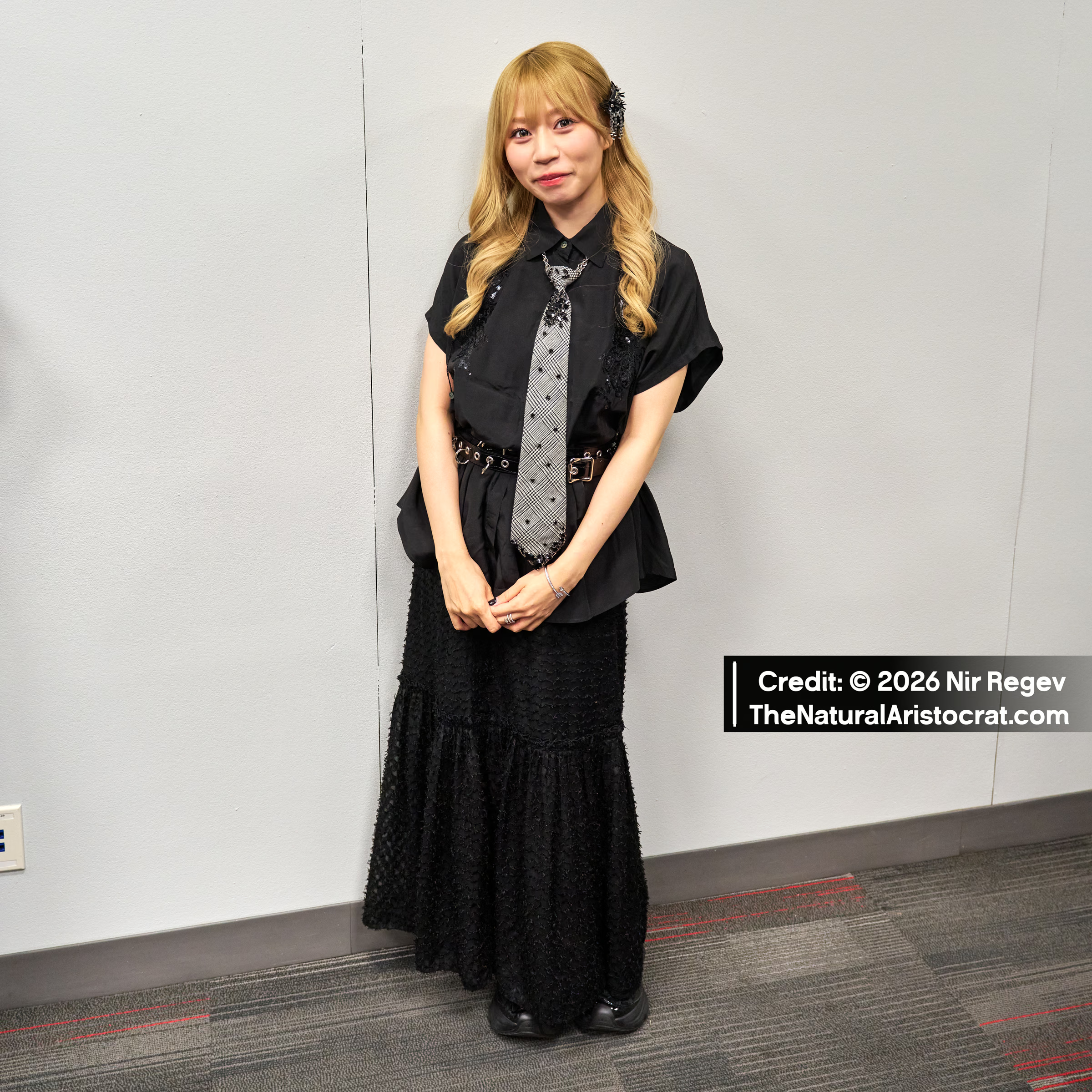
Rui Tanabe, full length. Photograph © 2026 Nir Regev · The Natural Aristocrat®
THE NATURAL ARISTOCRAT (NIR REGEV): To Tomori and Rui – What do you admire the most about each other’s performance?

Tomori Kusunoki and Rui Tanabe, who play Kanade and Mafuyu. Photograph © 2026 Nir Regev · The Natural Aristocrat®
TOMORI KUSUNOKI: I really love her voice, and I think there is a kind of shadow inside the model-student quality, very much there in the sound of her voice to begin with. But of course there’s also the switching in her acting, and it isn’t only the bright side and the dark side. When the emotion rises really high, the way she produces her voice has real force to it.
She gives performances with an almost frightening intensity. I think the way she brilliantly commands a character with such a wide emotional swing, makes it her own, is genuinely remarkable. And since we don’t record the game together, I’d even like to see how she records it.
EUGENE MUSINSKI: In the recording booth, right? Because they don’t see each other when they record.
ANIME CORNER: But in the movie, you did, right?
EUGENE MUSINSKI, to the actresses, in Japanese: In the movie, you recorded together, right?
TOMORI KUSUNOKI: We were together.
EUGENE MUSINSKI: That’s right.
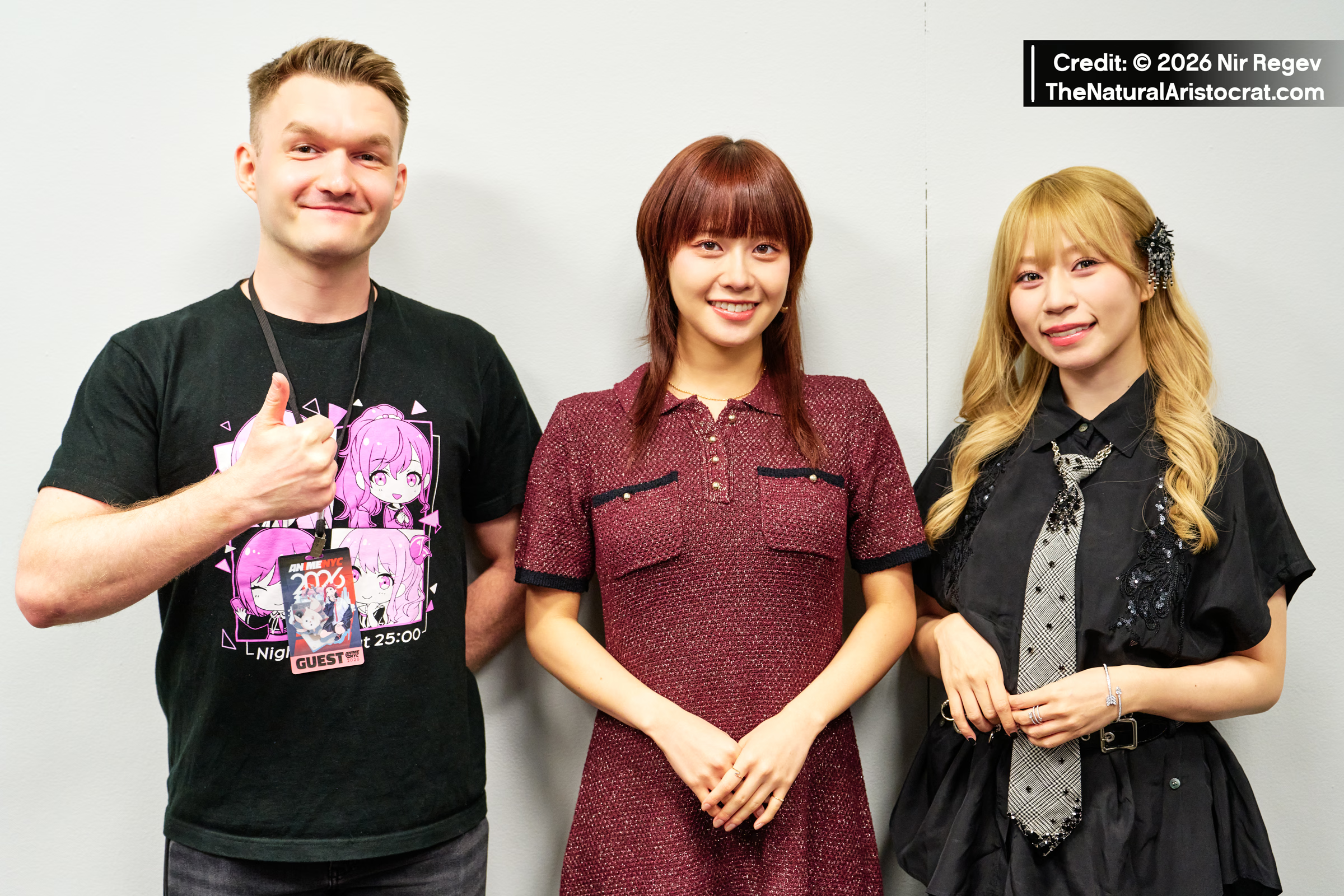
Eugene Musinski, who answered alongside the actresses throughout. Photograph © 2026 Nir Regev · The Natural Aristocrat®
RUI TANABE: I think it’s the fragility and the inner strength of Kanade that only Tomori can bring out. She writes songs herself, she has a real creative streak, and because that side of her is close to Kanade, she can bring out Kanade’s fragility, her strength, and I think it’s a performance where you feel the heat on the inside. I think it’s full of a charm nobody else could imitate.
EUGENE MUSINSKI: And there’s nobody who could do the Kanade part as well as her, because she’s a performer, she’s a musical artist, and she makes those songs. That’s a wonderful thing and it’s really unique. Her voice is unique and it matches the character perfectly.

Tomori Kusunoki and Rui Tanabe, full length. Photograph © 2026 Nir Regev · The Natural Aristocrat®
THE INTERPRETER, to Rui Tanabe: Is it music for Mafuyu, or your own music?
RUI TANABE: I listened to Hatsune Miku’s songs from the time I was small, so being able to sing Miku’s songs as a voice actor, as Mafuyu, makes me very happy.
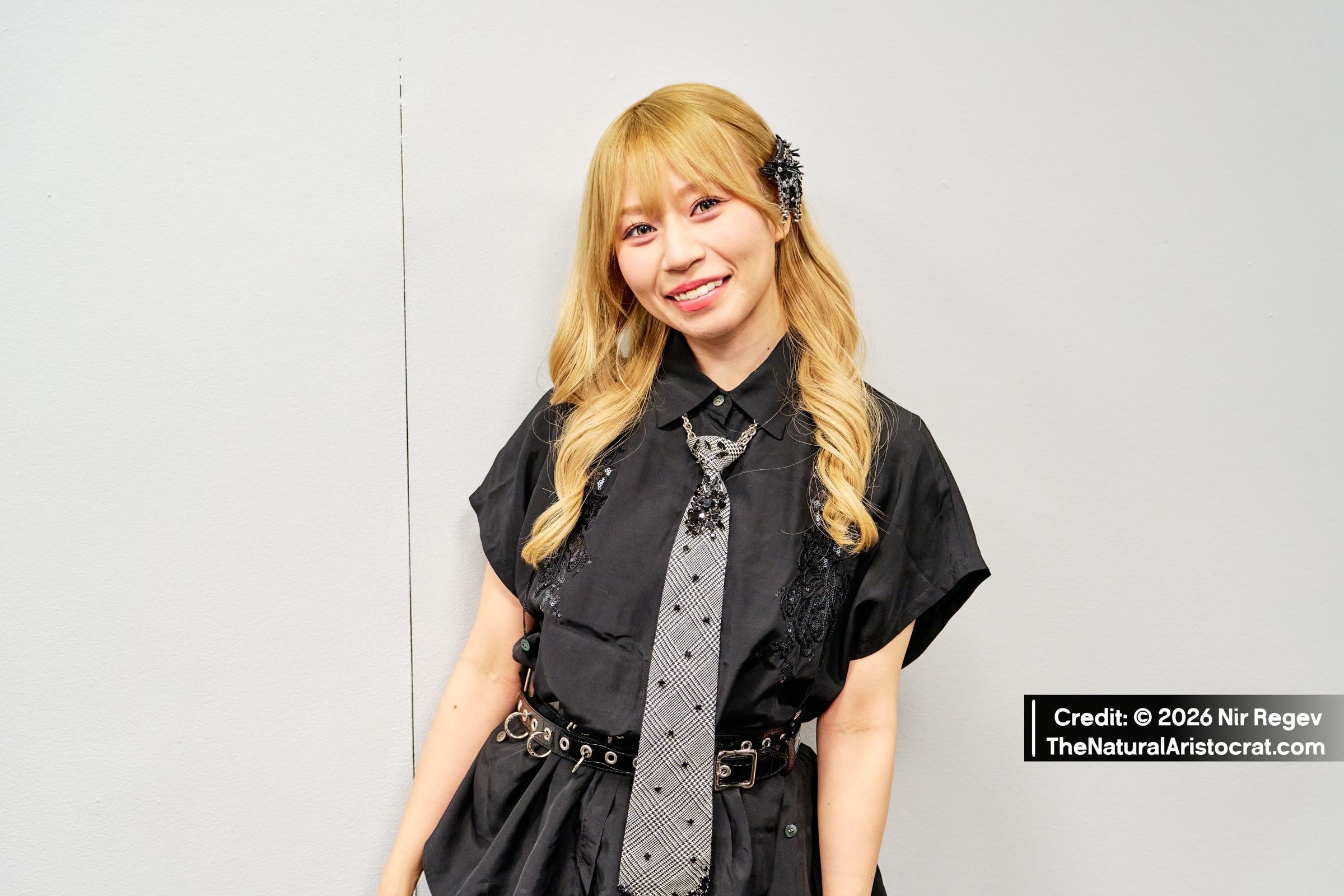
Rui Tanabe at the Javits Center. Photograph © 2026 Nir Regev · The Natural Aristocrat®
ANIME TRENDING: Project Sekai is such a unique game that not only do you have Miku and the other Vocaloids, but you also have unique characters singing alongside them. Why do you think Project Sekai and 25-ji are so popular, not only in Japan, but with overseas fans as well?
TOMORI KUSUNOKI: To begin with, I think part of it is that Hatsune Miku as a Vocaloid was enormously popular and had a lot of fans. On top of that, the characters have stories, and because there are so many different characters, there are a lot of points each person can relate to.
Different readings of the lyrics come out of the songs as well, and that gave it depth. I think that may be one reason.
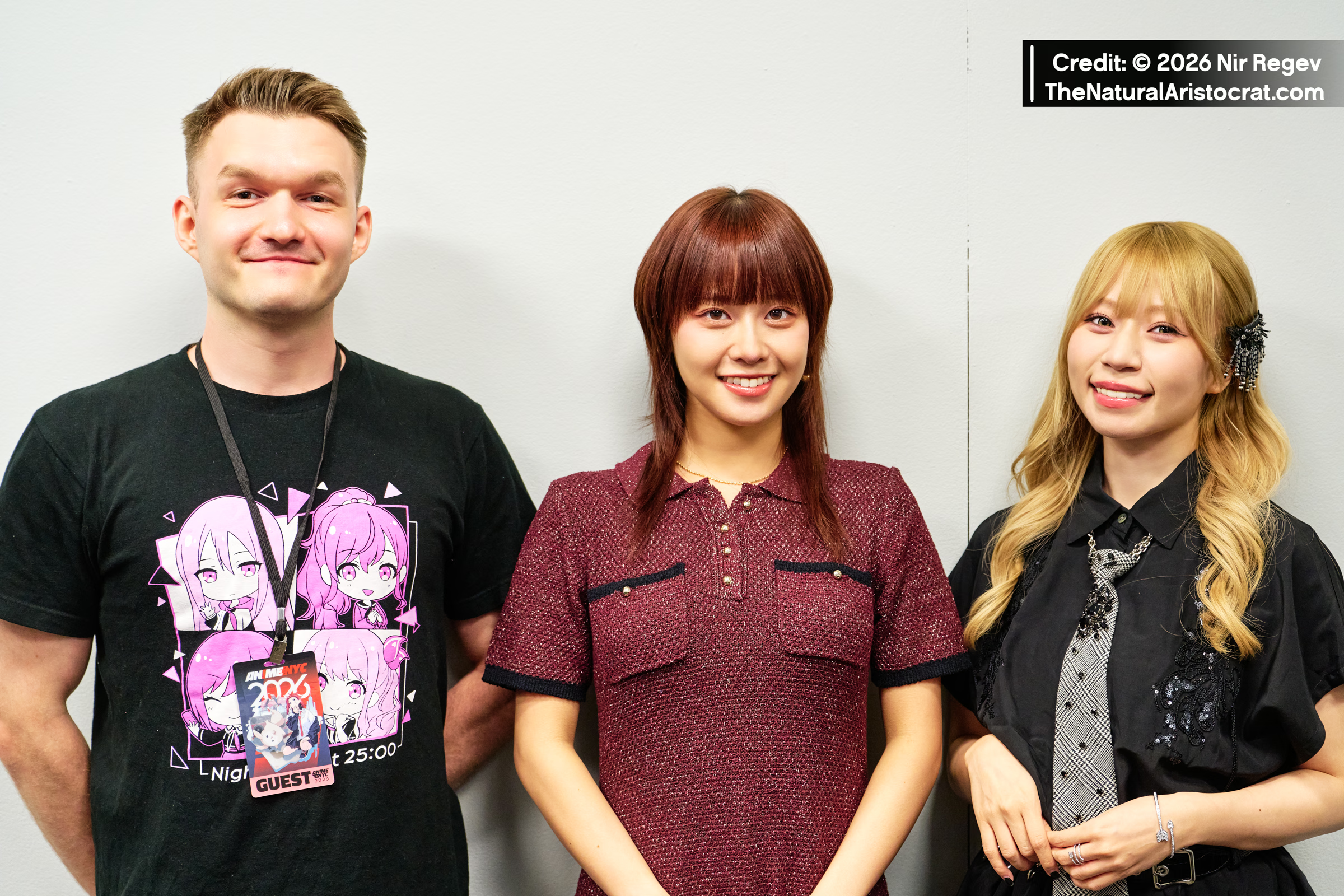
Eugene Musinski, Tomori Kusunoki and Rui Tanabe at the end of the press conference. Photograph © 2026 Nir Regev · The Natural Aristocrat®
EUGENE MUSINSKI: Just to expand on that, she mentioned there are a number of different types of songs. There are a number of different groups and units in the game, and each has a theme. There’s a band, there’s an idol group, there’s the dark depression girls, there’s a rap group, or street singers.
Each has a different genre, which means we can bring in fans from a lot of different kinds of music. It’s not just idol music. Our demographic is much wider than doing Vocaloid by itself. Also, having wonderful talent like them on the team. The reason they’re here is these original characters. If we had gone with Vocaloid alone we would be quite limited in what we could bring to the audience.
Now we have all these talented voice actors who are also genuinely good singers, so we can bring a lot of their emotion and personality into the game.
RUI TANABE: Ichika and the others meet Miku, and their world starts to change. That process overlaps with your own, so I think the audience, too, relates to it and comes to love it.
I was saved by Miku myself, and that’s how I became who I am now. Because there are characters like that to relate to, I think a lot of people see themselves in them and come to love the work even more.
ANIME CORNER: What advice would you have for fans who might be facing situations like those in Nightcord, or Niigo, whether it’s hiding yourself, high expectations, or blaming yourself? And this is for everyone, too.

Rui Tanabe, who voices Mafuyu. “Song is the place where she can let out her pain,” she said of the character. Photograph © 2026 Nir Regev · The Natural Aristocrat®
EUGENE MUSINSKI: I’ll start. It’s difficult to give specific advice, do this and this and this, because every person is different and we have such a wide range of fans playing daily. But specifically for people who are, let’s say, similar to Mafuyu, who hide themselves.
This is from Eugene the person, not the person running Colorful Stage. I think it’s really important to just be yourself in these situations. There are so many people in the world, whether in your school or outside it, so many different communities that feel similar to how some of our fans feel.
There is always a community for someone. You just need to find it, and to find it you need to get out there, show yourself, be true to yourself, and be happy with who you are.
Once you find that happiness, once you begin to accept yourself, the people around you follow, and you’ll find your group, you’ll find your niche. That’s also a point in [Nightcord], isn’t it? They start online.
They found their little safe corner, but they all still have similar interests and they still have fun together. I think the same thing can be found in real life.
Through the game we try to show that a lot of different people with a lot of different personalities go through difficult moments, but through perseverance, or through finding common interests, or through finding their own little niche, they find happiness, and they move forward through hard work as well.
So looking at things like that would probably be my advice. But it’s a personal thing rather than from the game side. Hopefully the story also helps our fans find themselves and connect with other Colorful Stage fans who might be in a similar situation, through our Discord or on social, and create this little community, maybe even at Anime NYC.
EUGENE MUSINSKI, summarizing his own answer in Japanese: To put it lightly: I went quite deep there, but if you live as yourself, people like you will probably gather around you. Put simply, it’s something like that. If you don’t act like yourself, it goes wrong instead, the way it does for Mafuyu. If you spend all your time feeling like you aren’t yourself, there are going to be times you’re a little sad, too.
There are all kinds of personalities in the world, so if you live as yourself, your friends, people like you, are definitely out there somewhere.
Once you take that step out, other people gather too, and you make a group of friends, like the various Project Sekai characters, friends coming together and doing their best in all kinds of situations, and enjoying that. So what I said was that life has a lot of fun in it. Something like that.

The three of them after the session. Photograph © 2026 Nir Regev · The Natural Aristocrat®
TOMORI KUSUNOKI: I strongly agree with Eugene, and I think what matters is finding an ally. That isn’t limited to people, to family or friends. It includes the music I mentioned earlier, and the things you love. Anything that can become the reason you come to like yourself is, I think, an ally.
So I’d be happy if Project Sekai, too, could be one of somebody’s allies. And I think we as actors probably perform hoping to convey that kind of thing, so I’d be glad if people keep enjoying Project Sekai in that spirit.
EUGENE MUSINSKI: So it doesn’t have to be people. Music, hobbies, movies, games. And within that, if Project Sekai is one of those things that helps you, we’re really happy.
RUI TANABE: I want everyone to play a lot of Project Sekai. Listen to the songs you like, watch the stories you like, and keep adding to the things you love. Then you get brighter and brighter, and I think you end up in an environment where there are a lot of friends around you, too.
YAHOO! JAPAN: My prepared question overlaps a little with what you said earlier. What do you have in common with the characters you play? Is there anything you would add?
RUI TANABE: I end up being the good kid too, so Mafuyu and I are actually very similar. On the inside I think about a lot of things, I agonize, I have painful thoughts, and I think that part of me resembles Mafuyu. I’ve been saved a great deal, so I want Mafuyu, too, to have more and more of those experiences from here on.
TOMORI KUSUNOKI: Kanade really doesn’t treat herself as important. She’s a girl who can spend her feelings and her strength for someone else’s sake. I’m the same type, in that, if anything, I end up wanting to do my best for someone else rather than for myself.
But that personality has also brought me all sorts of failures and regrets. So while I think it’s a good thing, I now feel I want to take better care of my own feelings too, just like Kanade.
DEAD RHETORIC: Being an actor requires a deep understanding of your character beyond what’s provided in the source material. What’s one habit your character has that isn’t in the script but you’ve always imagined?
TOMORI KUSUNOKI: For Kanade, even the materials I was given at the start were enough. They described her individuality, her personality, extremely well, so of course there was plenty I could relate to from the beginning.
And with Project Sekai there are a great many scenarios, and the characters get dug into a lot, so every time I play her I understand more. So I didn’t really struggle with playing her.
RUI TANABE: She’s similar to me, so I never struggle at all with the acting. I may not look it, though. The only place it gets difficult, technically, is that Mafuyu has her bright tone when she’s being the model student, and her dark tone when she’s with everyone in 25-ji [Nightcord].
It isn’t recorded by stopping at that point and going again. Mafuyu is recorded straight through, so there’s none of the stopping you usually get in voice work while I’m speaking as Mafuyu. Like everyday life, it flows from the bright tone into the dark tone and from the dark tone back into the bright tone.
So switching and performing in one flow, without stopping the recording, is the part that’s quite demanding.
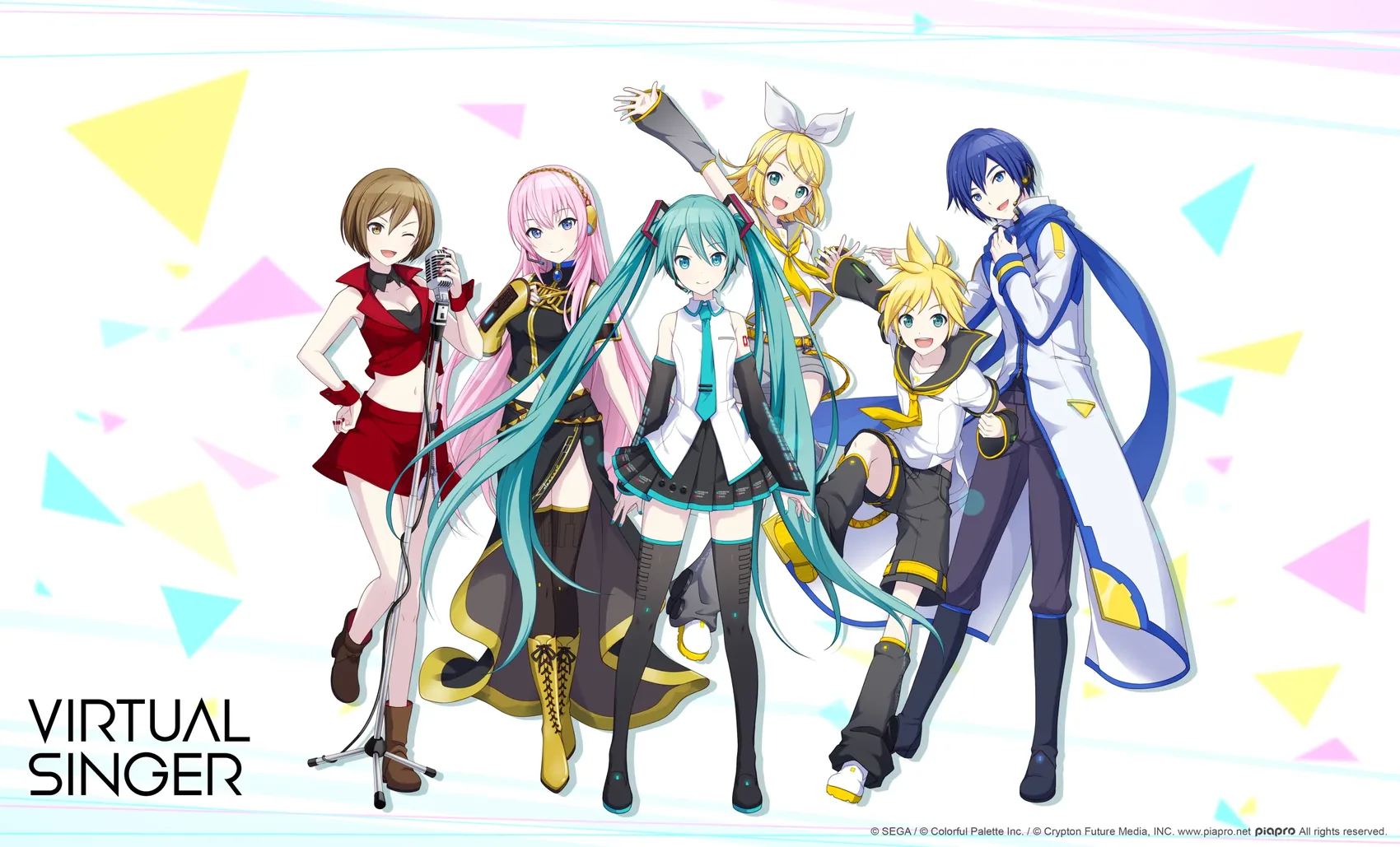
Hatsune Miku: Colorful Stage! press asset. © SEGA · © Colorful Palette Inc. · © Crypton Future Media, INC.
Read more
Mona Kimura vs. Marine Nicol: The Midas KickThe Lobby
The conversation after the interview